Multilingual Family: Learning a new language as a family.
We all reach maturity with competence in verbal language. Most of us didn't notice how we got to this level, and we instinctively teach our own children how to talk without putting a lot of thought or effort into it. Communication is a natural part of being human. But we do know that some people are much more adept at learning language(s) and seem to have more natural capacity.
When we take our family to a new country, or if we want our children to have the capacity to speak a second language (even one we know ourselves) we often rely on a school to teach them. This can be a great way to learn--if it is done well. But throwing a child into a classroom where they don't understand more than a few basic words is highly stressful for them. they may hide the stress but it is likely interfering with their ability to learn a new language in a foreign context.
Additionally, most families expect the parents to learn in one style and classroom while children are put alone into another style and classroom. By combining a view of language learning that has worked well for adults with a style that is best for children, families can learn together and build stronger connections with each other as the language becomes a part of their daily lives. Seeing mom and dad go "off" to learn language and being left with strangers can be hard on children. Working together can help overcome some of the culture shock that happens when a family moves to a new location.
My book, Family Friendly Language Learning (in Beta testing now--if you want to read and give feedback) takes a look at what language is designed for--its purpose in our lives. Language builds relationships so that we understand not just what each other is saying or wanting to achieve--but also to know each other. To understand and acknowledge who we are and how we impact each other in life. This is far richer than just "getting a job done."
One of the biggest misses in the curriculum outlines for language learning for children and adults alike is that that relationships are key to language acquisition, By putting the outline for language learning into a playful context, the relationship can develop and then those learning a new language can flourish with optimal brain power for acquiring the language rather than "learning" it from a page.
In this book you will be resourced with The Connected Language Learning Word List which outlines how to put vocabulary together in a way to understand more vocabulary efficiently without needing to speak (at first). With each lesson, you create a memorable recording for listening and remembering what you came to understand using play and playfulness to gain understanding of words.
There are also resources available for sale with multiple pages of pictograms that can be used for a variety of games that will give reminders and exposure to vocabulary that can be understood. The repetition will allow your brain to then acquire the language.
This curriculum is ideal for ages 4-12, but it works just as well for teenagers if they are given opportunities to make choices for themselves and if they have lots of say in how the recorded pieces are produced.
You can view and purchase these games click here for product page.
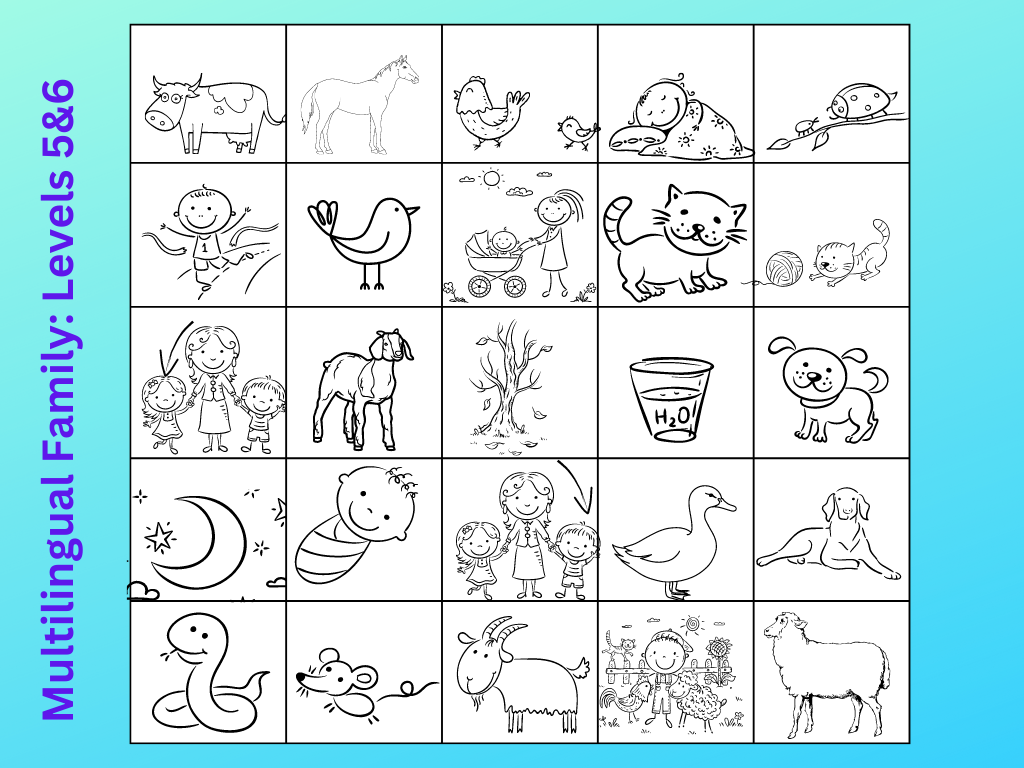
Below is an example of a game card for use in a variety of games for reviewing words you have learned.
When we take our family to a new country, or if we want our children to have the capacity to speak a second language (even one we know ourselves) we often rely on a school to teach them. This can be a great way to learn--if it is done well. But throwing a child into a classroom where they don't understand more than a few basic words is highly stressful for them. they may hide the stress but it is likely interfering with their ability to learn a new language in a foreign context.
Additionally, most families expect the parents to learn in one style and classroom while children are put alone into another style and classroom. By combining a view of language learning that has worked well for adults with a style that is best for children, families can learn together and build stronger connections with each other as the language becomes a part of their daily lives. Seeing mom and dad go "off" to learn language and being left with strangers can be hard on children. Working together can help overcome some of the culture shock that happens when a family moves to a new location.
My book, Family Friendly Language Learning (in Beta testing now--if you want to read and give feedback) takes a look at what language is designed for--its purpose in our lives. Language builds relationships so that we understand not just what each other is saying or wanting to achieve--but also to know each other. To understand and acknowledge who we are and how we impact each other in life. This is far richer than just "getting a job done."
One of the biggest misses in the curriculum outlines for language learning for children and adults alike is that that relationships are key to language acquisition, By putting the outline for language learning into a playful context, the relationship can develop and then those learning a new language can flourish with optimal brain power for acquiring the language rather than "learning" it from a page.
In this book you will be resourced with The Connected Language Learning Word List which outlines how to put vocabulary together in a way to understand more vocabulary efficiently without needing to speak (at first). With each lesson, you create a memorable recording for listening and remembering what you came to understand using play and playfulness to gain understanding of words.
There are also resources available for sale with multiple pages of pictograms that can be used for a variety of games that will give reminders and exposure to vocabulary that can be understood. The repetition will allow your brain to then acquire the language.
This curriculum is ideal for ages 4-12, but it works just as well for teenagers if they are given opportunities to make choices for themselves and if they have lots of say in how the recorded pieces are produced.
You can view and purchase these games click here for product page.
Below is an example of a game card for use in a variety of games for reviewing words you have learned.
Imagination Station
This product is not yet posted for public sales. Contact me if you would like to know more and be part of the pre-publications testing.
Imagination Station is a ten part series of skill-building language games you play with your child to prepare them for reading. Most reading programs focus directly on written language and do not establish a strong mastery of the sounds of language and the connection of those sounds to letter symbols before reading begins. These games work to establish pre-reading foundations or as a return to the basics for those children who are struggling to learn reading skills and have found reading challenging, maybe even disheartening.
In this series of games, you and your child (children) play games together using bingo cards and pictograms to practice skills that create strong foundations of language awareness. Once your child can easily distinguish sounds that start words, including digraphs and clusters, and can generate a set of words with those sounds, they are ready to start reading skills and learn about long and short vowels and sight words. The activities that start the series use sounds from the environment (animal noises, sirens, typical sounds in a home, etc) and then progress through rhyming words, opposites, homonyms and synonyms and compound words. All of these are learned without expecting children to write things down in workbook pages, so that the focus of attention is on the language skill rather than the fine motor skills (which are also necessary but best learned separately from language).
Imagination Station is a ten part series of skill-building language games you play with your child to prepare them for reading. Most reading programs focus directly on written language and do not establish a strong mastery of the sounds of language and the connection of those sounds to letter symbols before reading begins. These games work to establish pre-reading foundations or as a return to the basics for those children who are struggling to learn reading skills and have found reading challenging, maybe even disheartening.
In this series of games, you and your child (children) play games together using bingo cards and pictograms to practice skills that create strong foundations of language awareness. Once your child can easily distinguish sounds that start words, including digraphs and clusters, and can generate a set of words with those sounds, they are ready to start reading skills and learn about long and short vowels and sight words. The activities that start the series use sounds from the environment (animal noises, sirens, typical sounds in a home, etc) and then progress through rhyming words, opposites, homonyms and synonyms and compound words. All of these are learned without expecting children to write things down in workbook pages, so that the focus of attention is on the language skill rather than the fine motor skills (which are also necessary but best learned separately from language).